
10 Most Affordable Areas To Buy A House Within 60km of Copenhagen
Copenhagen is one of the most popular cities in Europe for internationals. It is considered one of the best cities to live in, and Denmark has consistently ranked among the happiest countries in the world.
Copenhagen’s bike-friendly layout, cozy vibe, and kid-friendly atmosphere, combined with a healthy work-life balance, make it one of the best cities to live in.
The only downside to living in Copenhagen is the housing affordability (or lack thereof). As demand has grown, so too have property prices within Copenhagen itself. For many newcomers, buying a home in the city is financially out of reach.
This has led an increasing number of both Danes and internationals to look beyond municipal borders to surrounding towns and suburbs that offer more affordable housing, while still providing convenient access to the capital’s jobs, culture, and lifestyle.
And you don’t have to move far to see housing prices decrease significantly. Within 60 kilometers of Copenhagen, you see the prices of detached and terraced houses decrease by 80% compared to similar houses in the center of Copenhagen. For apartments, the price decreases by more than 50%.
In this article, we explore the 10 most affordable areas to buy a house within 60 kilometers of Copenhagen, ranked from highest to lowest cost. These locations allow you to enjoy the benefits of living and working in one of Europe’s most attractive capitals without paying premium inner-city prices.
Why so many internationals move to Copenhagen
Copenhagen has quietly become one of Europe’s most desirable cities for international professionals and families alike. As Denmark’s capital, it combines Scandinavian design, political stability, and economic strength with a lifestyle that consistently ranks among the best in the world.
One of the key reasons Copenhagen attracts global talent is its strong economy and innovation ecosystem. The city is a hub for clean tech, life sciences, IT, shipping, and design, with multinational companies and startups operating side by side.
Denmark’s flexible labor market model, often referred to as “flexicurity,” makes it relatively easy to change jobs while still benefiting from social security and worker protections. For many expats, this balance of opportunity and security is a major draw.
Work-life balance is another defining feature. The Danish workplace culture values efficiency over long hours, and employees benefit from generous parental leave, vacation time, and a flat organizational structure that encourages open dialogue.
Combined with a reliable public transport system, safe cycling infrastructure, and short commuting times, daily life feels manageable and human-centered.
Copenhagen is also known for its safety, cleanliness, and social trust. Crime rates are low, public services are efficient, and healthcare and education are of high international standards. The city consistently ranks high in global livability indexes, and its compact size means you are never far from green parks, waterfronts, or the sea.
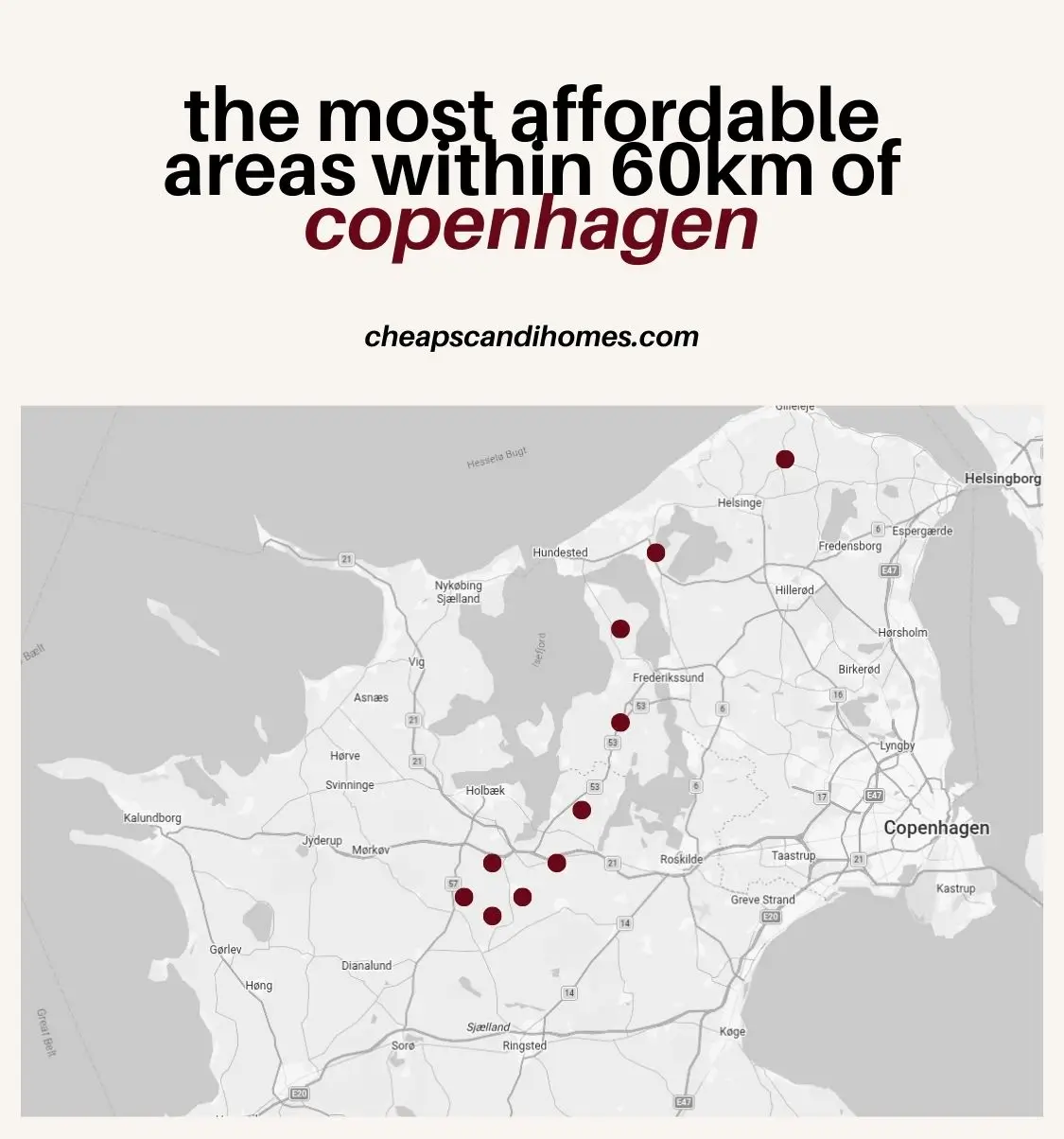
The 10 Most Affordable Areas within 60km of Copenhagen
Let’s take a look at the 10 most affordable areas within a 60km radius of Copenhagen. For this list, we only looked at housing prices in Denmark. But thanks to the Öresund bridge and train connection, you can even look across the border to South Sweden for more affordable housing.
1. Kirke Hyllinge (55km)
Kirke Hyllinge (postal code 2040) is a town and parish in the Lejre Municipality in Zealand, around 55 kilometers west of Copenhagen. The town features a kindergarten and school, as well as sporting facilities.
On average, the price of a house in Kirke Hyllinge is DKK19,856 per m2 (compared to DKK90,000/m2 for a similar house in central Copenhagen). DKK19,856 is approximately $3,140.
2. Græsted (53km)
Græsted (postal code 3230) is a town in the Gribskov Municipality in North Zealand, around 53 kilometers north of Copenhagen. The town has its own railway station, and a trip from Copenhagen Hovedbane takes about 1 hour.
On average, the price of a house in Græsted is DKK18,477 per m2 (compared to DKK90,000/m2 for a similar house in central Copenhagen). This is approximately $2,928.
3. Frederiksværk (54km)
Frederiksværk (postal code 3300) is a town in the Halsnæs Municipality in North Zealand, around 54 kilometers north-west of Copenhagen. The town has a railway station, and a trip from Copenhagen Hovedbane takes around 1 hour and 15 minutes. The town is situated by the Roskilde Fjord.
On average, the price of a house in Frederiksværk is DKK17,958 per m2 (compared to DKK90,000/m2 for a similar house in central Copenhagen). DKK17,958 is approximately $2,846.
4. Tølløse (60km)
Tølløse is a small town in Holbæk Municipality, about 60 kilometers west of Copenhagen, with several schools and a church. The town has a railway station, making it a perfect place to commute to the capital. The direct train from Copenhagen Hovedbane takes around 55 minutes.
On average, the price of a house in Tølløse is DKK16,669 per m2, which is approximately $2,642.
5. Jægerspris (50km)
Jægerspris is a small town in Hornsherred, a peninsula between Roskilde Fjord and Isefjorden. The town is situated about 50 kilometers north-west of Copenhagen. The town is the home of Jægerspris Castle, and north of the town lies the Jægerspris Forest with ancient trees.
On average, the price of a house in Jægerspris is DKK16,089 per m2, which is approximately $2,550.
6. Skibby (60km)
Skibby is a small town on the Hornsherred peninsula in Zealand, about 60 kilometers west of Copenhagen. The village has several schools and sports facilities.
On average, the price of a house in Skibby is 15,762 per m2, which is approximately $2,500.
7. Kirke Såby (52km)
Kirke Såby is a small village in the Lejre Municipality in Central Zealand, about 52 kilometers west of Copenhagen.
On average, the price of a house in Kirke Såby is DKK 13,736 per m2, which is approximately $2,177.
8. Kirke Eskilstrup (60km)
Kirke Eskilstrup is a small town in the Holbaek Municipality, about 60 kilometers west of Copenhagen. Even though the town is very small (661 inhabitants in 2025), it has its own railway station, and a trip from Copenhagen Hovedbane takes 1 hour.
On average, the price of a house in Kirke Eskilstrup is DKK 11,923 per m2, which is approximately $1,889.
9. Store Merløse (65km)
Store Merløse is a small town in the Holbæk Municipality, about 65 kilometers west of Copenhagen. The small town has several schools and other amenities, such as shops and sports facilities. The town has a railway station, and a trip from Copenhagen Hovedbane takes about 1 hour.
On average, the price of a house in Store Merløse is DKK 10,166 per m2, which is approximately $1,611.
10. Ugerløse (70km)
Ugerløse is a small town in the Holbæk Municipality, about 70 kilometers west of Copenhagen. The small town (909 inhabitants in 2025) has a daycare facility and a school up to grade 6. After that, the children have to go to school in Tølløse.
On average, the price of a house in Ugerløse is DKK 9,242 per m2, which is approximately $1,464.
The Most Affordable Place in the Capital Region of Denmark
If you want to live in the Capital Region of Denmark (Region Hovedstaden), prepare for high housing prices. Of course, some areas are more affordable than others.
The most affordable areas to buy a house or apartment in the capital region of Denmark are located west of the city center, namely: Ishøj, Albertslund, Hoje-Taastrup, Brøndby, and Glostrup. Prices for a detached or terraced house in these areas are around DKK 30,000 per m2.
The most expensive areas are the city center, Frederiksberg, and the areas along the coast (such as Klampenborg, Charlottenlund, and Hellerup).
Thanks to Denmark’s compact size and good transport, there are many opportunities to work and enjoy Copenhagen while living in a more affordable area. Even in areas south of Copenhagen, you can find more affordable properties, with a commute time of around 1 hour.
Take a look at Cheap Scandi Homes’ Zealand tag to look at properties relatively close to Copenhagen that don’t break the bank.
cover image credit: Dietmar Rabich / Wikimedia Commons / “Kopenhagen (DK), Nyhavn — 2017 — 1447” / CC BY-SA 4.0
,_Nyhavn_--_2017_--_1447.jpg)